Showing posts with label alternative energy. Show all posts

Wednesday, August 25, 2010

You want me to fill that up with WHAT?

The long sought "philosophers stone" of the biofuel movement is a biofuel developed from waste products. While traditional biofuels require us to sacrifice productive land that could be growing food, waste biofuels are exactly what they sound like: biofuels made from waste like garbage, wood chips, or industry byproducts. The problem with waste biofuel is no one has ever been able to make one that is both scalable and doesn't take more energy to make then it can give back later. Until now.

Scientists are now one step closer to achieving both those goals, and it might surprise you to learn that the fuel that might soon be powering your car is the same thing that currently powers your late night dance dance revolution sessions: whiskey.

That's right. Scottish scientists have recently discovered a way to turn two byproducts of the scotch whiskey distillation process into butanol, a fuel that gives off almost 30% more power than traditional biofuels. The best part? Butanol can be used in cars with regular combustion engines with no modifications what-so-ever, meaning it could realistically become a part of our gas mixture as soon as production can be ramped up. The researches from Edinburgh University who developed the process have already applied for a patent and hope to start supplying the country with fuel in the next few years.

To be fair, the stuff you'll be putting in your gas tank won't resemble that nice single malt you have stashed under your bed. Heck, it won't even resemble Dewers. Still, if this technology ends up being scalable, it could give a whole new meaning the the phrase "one for the road."

Image provided by chipgriffin

Monday, June 14, 2010

Is Obama Ready to Put His Weight Behind an Alternative Energy Bill?

For months, bloggers and news organizations have weighed in (and in and in) on whether or not Obama's clout is required to move the climate bill out of limbo, and whether he and his aids are willing to put some of the presidents remaining political capital on the line for it. Early this morning, Obama seemed ready to answer that question. In a statement issued online to the millions who backed his presidential bid, the president asked his network to lend their names to a campaign to change the way America produces and consumes its energy. Later, in a speech he gave while visiting oil soaked Mississippi, Obama reiterated his support for an alternative energy bill: "Our continued dependence on fossil fuels will jeopardize our national security. It will smother our planet. And it will continue to put our economy and our environment at risk."

This is all encouraging news, but it still doesn't tell us if Obama is willing to put his money where his mouth is. He's passed a healthcare bill, he's averted the greatest monetary crisis since the great depression, and he's about to preside over a historic (if incomplete) financial reform bill. Will he have anything left for the environment? Looks like we'll have to wait and see.

Tuesday, April 13, 2010

Why You Should Burn Your Trash

I've felt strongly for some time now that the energy of the future was going to be waste (ie. trash). I was introduced to this theory through the peer reviewed scientific lens of Back to the Future (which also introduced me to the possibility of flying skateboards, more on that in another post).

In the film, Doc Brown's original fuel for his time traveling DeLorean is plutonium, whose hard to obtain nature lands Doc in a pretty sticky situation. At the end of the film however, after Doc goes to the future and refits his machine with a new fangled flux capacitor, all it takes to fuel the DeLorean are a few choice items he pulls out of Marty's trash can, replacing forever Docs reliance on dangerous, hard to obtain nuclear fuel. I find this fable sums up pretty well my own opinions on the subject: why should we deal with dangerous, dirty fuels when we have more than enough waste full of untapped energy to go around?

The answer of course is that while there are many theoretical options for tapping into that energy -- cellulosic ethanol, methane from landfills, thermal energy from compost heaps, algea biofuels, the list goes on -- we are simply not there yet. We currently do not have the technology to turn waste into fuel in a way that is both cost effective, non-toxic. According to an article in yesterdays New York Times however, the technology may finally be here to do just that. The most amazing thing about this new technology technology? It's not even a new technology at all.

The idea of burning garbage as fuel has been around for a long time, but in the modern era it can be traced back to the 1970's. The recently formed OPEC was driving energy prices up, and cities were running out of landfill space. This obvious set of problems spurred a few entrepreneurs to develop "garbage to energy" systems: these systems burned garbage to make steam, or ground it into fuel pellets. What seemed like a slam dunk however quickly turned into a big problem:

"Garbage to Energy Plants were expensive, and to finance them, cities signed (were asked to sign) long term contracts to deliver and pay for a guaranteed supply of garbage. If the city didn’t have enough garbage, it had to pay anyway. The incentive to recycle would be gone. Also, the energy calculations started with garbage = 0. But Garbage wasn’t worthless – it was full of stuff that could be reused and recycled. You could save more energy and other resources by recycling paper than by burning it, and then cutting trees to make new paper." (www.garbage.org).

Add in the fact that burning garbage releases hundreds of toxic chemicals into the atmosphere, and by the 1980's the garbage burning movement was dead. After all, how could we possibly make up for all of these huge negatives?

According to The New York Times, Denmark, and several other forward thinking European countries including Germany and the Netherlands, have found a way:

"Far cleaner than conventional incinerators, this new type of plant converts local trash into heat and electricity. Dozens of filters catch pollutants, from mercury to dioxin, that would have emerged from its smokestack only a decade ago. In that time, such plants have become both the mainstay of garbage disposal and a crucial fuel source across Denmark, from wealthy exurbs like Horsholm to Copenhagen’s downtown area. Their use has not only reduced the country’s energy costs and reliance on oil and gas, but also benefited the environment, diminishing the use of landfills and cutting carbon dioxide emissions... With all these innovations, Denmark now regards garbage as a clean alternative fuel rather than a smelly, unsightly problem."

Additionally, the creation of these plants has not led to a drop in the recycling rate of these countries, in spite of the fact that they currently have some of the highest recycling rates in the world. This may be attributed to the fact that in these countries local governments usually manage all trash collection, incinerators and recycling centers, and financial incentives ensure that recyclable materials are not burned. For example, communities may recycle free of charge, but must pay to have garbage incinerated. Turns out government incentives CAN be a good thing.

Is this really possible? Can Denmark really have found a way to create energy and divert trash from the landfill in a way that doesn't release toxic chemicals into the environment or decrease our recycling rate?

There are of course downsides to the program. While scrubbers do keep the most toxic substances out of the environment, there is still no way to properly dispose of them and they must be stored forever in a way similar to nuclear waste. And there is still the American public to consider -- after 30 years of being told we do not want any plants of this sort built, can we really be convinced that it is now a good idea? An interesting debate to be sure, but whether we decide to follow Denmark's lead or not, I am still waiting for my own trash fueled flux capacitor.

Image provided by Richard Berg

Wednesday, October 14, 2009

Alternative Energy Finds a New Ally... The US Military?

Yes, it's true. Alternative energy has found a very unlikely ally in the US military. While I never thought about it this way before, it actually makes perfect sense. A military needs an enormous amount of fuel to sustain itself, and getting that fuel to remote places where our troops need it is not only costly and inefficient, but extremely dangerous. After all, few things provide better targets than giant tankers filled with highly flammable liquid.

It turns out that the military has been aware of this problem for some time, but it took two big events to really underscore just how serious the problem was. The first was Hurricane Katrina, which caused a small increase in the price of a barrel of oil, but made a HUGE difference in the Department of Defense's operating budget. The second was a 2006 “Priority 1” request for emergency battlefield supplies from Marine Corps Major General Richard Zilmer. He requested “a self-sustainable energy solution,” including “solar panels and wind turbines,” to help prevent the men under his command from “[remaining] unnecessarily exposed” and “continue[ing] to accrue preventable ... serious and grave casualties.”

Since then, the military has started some serious alternative energy R&D, some of which might even have civilian applications (read: really awesome cars and clothes). While the total budget is still just a tiny fraction of the Pentagons overall spending (they expect to spend $1 billion this year), that kind of money is nothing to sneeze at.

I can't believe I am saying this but... rock on DOD?

For more information, check out this solid article on Grist.

Friday, August 14, 2009

NASCAR Going Green?

I should admit up front that I am no NASCAR or Indy 500 fan, and that I have a limited understanding of the sport and what goes on at these events. What I do know is that race car driving is not only the single most popular spectator "sport" in America, but that it is also not exactly “environmentally friendly.” Enter Leilani Munter. I was listening to NPR a few weeks ago and heard the following interview with Leilani, a professional race car driver. As it turns out, not only is she one of a mere handful of women in this male dominated sport, but she is also an ardent environmentalist committed to doing everything she can to “green up” this carbon intensive activity.

Listen to the NPR interview here

Basically, Leilani has been an environmentalist her whole life. She is a longtime animal lover and vegetarian, and she didn’t even get into race car driving until after receiving a degree in biology (specializing in ecology) from UCSD. When she did finally get behind the wheel of a race car, it didn’t take her long to come to the conclusion that her environmental views were somewhat at odds with her new profession. However, instead of abandoning race car driving altogether, she decided to use her platform as an important figure in the nation’s number one spectator sport to help move it in a new direction. As Leilani says, “It's a hugely popular sport, and… you can't leave behind a hundred million race fans.”

Since she started speaking out, Leilani has definitely run into mixed reactions. “Some people were telling me that they… wanted to see more people talking about our environmental problems on the racing circuit. But then, there were also others that were… very negative and kind of saying I was brainwashed by Al Gore.” Even with the mixed reaction, Leilani is hopeful, saying that “the important thing that I tried to look at is that I was getting them talking about it… to go into a NASCAR forum and see them arguing and talking about global warming and talking about climate change… Those kinds of things weren't necessarily taking place in NASCAR forums before.”

But Leilani's general awesomeness doesn't end there. In addition to bringing awareness of the green movement to racing fans, Leilani is also opening the way for smaller, green businesses to advertise in the racetrack. The way sponsorships usually work (based on my extensive research ie. Google) is that one major company will sponsor a car, meaning that each car becomes a giant billboard for that one company. Leilani’s vision is to buck that trend by breaking her car up into several smaller sponsorships placements that mid-size green companies can afford, and to have the main spot on the race car reserved as a "call to action" message for race fans: “One of the messages I wanted to send was about CFL light bulbs, and I would like to run a race car that has a CFL label on the side of it… And then the next race we'd run something different. It might be a race car that says, no more paper, no more plastic, and then I can talk about the plastic bags and how many of them aren't getting recycled.”

And as if all that wasn't enough, Leilani is also trying to take her green message directly to the fans. Apparently, another aspect of the race car world that I was unaware of is that each driver gets some space at the racetrack to sell their merchandise. Usually, this means action figures, jerseys, hats and bobble head dolls. Not at Leilani’s booth: “I'm going to be selling CFL light bulbs and canvas grocery bags and just giving them tips on things that they can do to go green.”

While I still don’t personally understand what people find entertaining about cars going around a circle for five hours, and while there is absolutely no escaping the fact that car racing will be one of the most carbon intensive sports for some time to come, I can’t help but be inspired by one woman’s efforts to bring her passion to her work in a way that will (hopefully) get all of us a little closer to a sustainable planet.

Read all about Leilani's newest actions at her blog: carbonfreegirl.com

Image provided by Wikipedia

Tuesday, May 5, 2009

Government Incentives Can Be A Good Thing

This post is a little more political than I usually like to get (at least on this blog) but I just finished reading a great article on energy efficiency and why some direct government involvement is necessary to make that happen, and I thought the article deserved a shout out. You can read the full article and it's in-depth awesomeness here (Energy Efficiency), but the main points are that:
  • Resource intelligence (aka energy efficiency) is profitable. Study after study (after study) shows that homes and businesses have available a range of investments, technologies, and practices that cut energy use and pay handsome returns. (For example, this three-year study of efficiency in buildings.)
  • Resource intelligence isn’t happening on its own. Despite the aforementioned studies, people aren’t taking advantage of the opportunities at anything close to the available scale. The low-hanging fruit stubbornly remains unplucked. (Maybe because the people looking at that fruit aren't doing enough synergizing and social media research)
  • Resource intelligence is central to the climate/energy challenge. The International Energy Agency describes a scenario for achieving 450 ppm (the widely shared though likely inadequate target for atmospheric concentrations of CO2). Of the emission reductions they project, energy efficiency is responsible for 54%.
  • There’s need for public-private partnerships to restructure markets or create new ones. Market economics leads to a somewhat passive view of public life, wherein our collective welfare is entrusted to markets, to millions of allegedly rational individuals. But here we have a problem—the deterioration of the atmosphere—that presents us with great urgency, and a solution—resource intelligence—that requires our active intervention.
Basically, we have a situation where a 100% rational person would be investing in energy efficiency, but they aren't for any number of reasons, some good and some completely ridiculous. In order to get these people to make the decisions which are good for their health, their wallets and the environment as a whole, we need to educate them and/or give them some more incentives. Sounds good to you? Me too.

Thursday, April 23, 2009

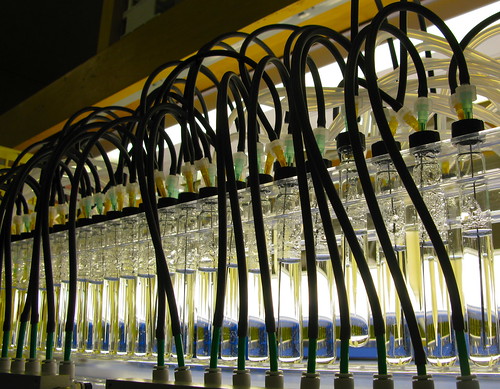
Can Algae Outperform Other Biofuels?

Here’s an article on the ever growing “algae revolution” where people stop chanting “drill baby, drill” and start chanting “grow baby, grow.” There are definitely upsides to algae, but do they outweigh the problems?

One group of people who say yes are the shrimp farmers in Gial Bend, AZ. Here, the newest algae project is not controlled by an army of scientists or funded with millions of dollars worth of government research grants. Rather, it's a desert shrimp farm changing with the times to produce biodiesel from algae, using some of the same algae that feed the shrimp.

With biodiesel prices at $4.81 a gallon, according to the U.S. Department of Energy, these shrimp farmers hope to produce it for less than $3 a gallon. With these small farms being capable of producing 5,000 gallons of biofuel per acre in two years, there is definitely something to be said.

Algae is transformed into biofuels by pressing the oil out of the algae and then adding lye, sodium and ethanol as a catalyst to make the fuel more pure. The lye, sodium and ethanol can be reused.

Biofuels made from algae have an advantage over biofuels made from soybeans, palm oil or corn because algae is not a source of food, growing algae does not use agriculturally fertile land and algae can be grown in treated wastewater.

FROM ALGAE TO FUEL

* Algae is turned into biofuel in a process called transesterification.

* Biofuels made from algae contain around 90 percent of the energy in regular diesel but produce less CO2.

* Some forms of algae consist of more than 50 percent oil.

* Many vehicles would not have to convert to run on biodiesel.

FUEL POTENTIAL

Biodiesel potential, according to a report from the University of New Hampshire :

* 7.5 billion gallons of biodiesel can be produced in an area of 780 square miles.

* Biofuels take advantage of solar energy because plants use photosynthesis to convert solar energy into fuel.

* Certain strains of algae are among the most photosynthetically efficient plants.

* 15,000 square miles of algae production could replace all the petroleum-based transportation fuels needed in the United States.

Now if I could only start selling the algae growing on my f*&#ing fishtank...

Image provided by jurvetson

Monday, March 2, 2009

A Saudi Islamic scholar says ethanol-powered vehicles go against the Koran

The Huffington Post reported today that a Saudi Islamic scholar has warned his students not to drive ethanol powered cars because their reliance on alcohol to run contradicts the Muslim rule to avoid alcohol.

The scholar stopped short of issuing a fatwa, saying instead that this was his recommendation and that further dialog on the issue was required.

Read the full article here.